Building acandle maker.
The pumpkin tools suggested another object to shape, carve and light. A candle adds a new challenge: its surface has to change as it burns.
October 2026 · A working study from the pumpkin project ↗
Start with a base, adjust its shape, choose the wax and wick, then light it. The burn control lets you explore how the design changes over time. The 3D scene loads on launch and closes with the lab.
New forms from familiar controls.
Pillar, taper, votive, sculpted candle and hollow luminary are five starting bases. They share a body generator derived from the pumpkin’s lobe sampler. Width, height, waist, ribs and twist change the silhouette, with handles on the object for direct edits.
The wick reuses the stem’s curve builder at a different scale. Its length and curl give the flame a place and direction. Cotton braid, square braid, cored, wood and hemp options let the prototype vary wick appearance and flame behaviour.
This study supports a single central wick and bodies built around an axis, including ribbed and twisted variations. Arbitrary figurines and multiple interacting flames would require further work.
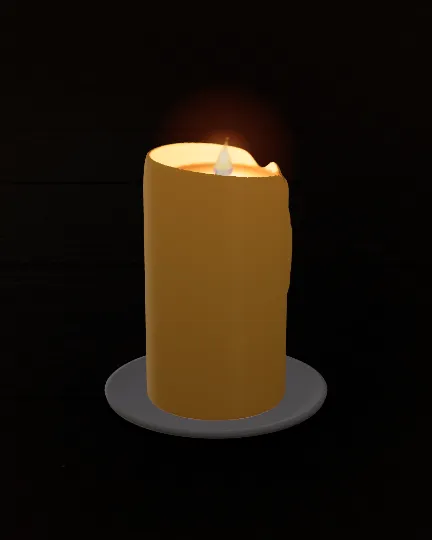

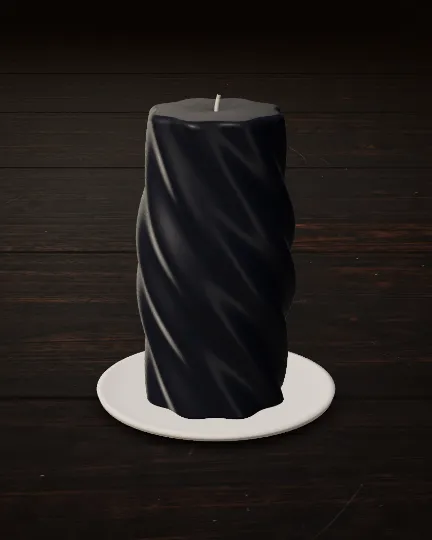
Burning changes more than the flame.
Scrubbing through a burn lowers the melt pool. A rim can survive as a shell; a deeper pool can become a tunnel. The flame’s direction affects the rim, giving escaping wax a lower path down the side.
Wax type and colour remain independent. Paraffin, soy, beeswax, coconut, palm and stearin use different settings for burn rate, dripping, surface frost and glow. Changing the colour should not quietly select a different burn behaviour.
These are authored material and burn approximations. The hour settings provide a way to explore this model. A full simulation of heat flow through the wax remains outside its scope.
Make the drips part of the surface.
Escaping wax reuses our particle slurry solver. It travels down a representation of the candle wall, cools and freezes. That wall model simplifies angular curvature and rib relief, so this remains a controlled visual approximation.
Frozen drops blend into a signed distance field: a grid describing which points are inside or outside the candle. Carving and scraping remove material from the same solid description. A marching-cubes mesher turns its boundary into the visible surface.
This gives the tools a common result. A drip can build up the wax; a cut can take it away. A hollow luminary leaves a shell for light to pass through. Grid resolution limits the smallest detail, which can soften or disappear.
Rebuilding a detailed solid at every pointer move would interrupt shaping. A quicker mesh follows the drag, then the detailed surface replaces it when the control rests. It keeps the gesture responsive while retaining the solid operations for the settled result.
Save the design with the picture.
Shape, wax, wick, cuts and burn state fit in a versioned recipe. Seeded burning and drips make their variation repeatable. A shared link carries the description so another browser can rebuild the design without downloading its generated mesh.
Taking a photo also saves a thumbnail and recipe in this browser’s gallery. That collection stays on the device; the share link is what carries an individual design elsewhere.
The study tests how far the existing tools can travel: the pumpkin supplies the body controls and wick curve, scraping contributes surface and solid experiments, and the candle adds melting, drips and a different material response.