Scrapingpumpkins.
A shallow scrape can become a line of light. This study works through the surface model, tool behaviour and depth control needed to make that possible.
October 2026 · A working study from the pumpkin project ↗
Drag across the slab, change the tool and compare repeated passes. Turn on backlight to see the remaining wall become a picture. The 3D scene starts when you launch it; Close releases it.
A surface that remembers.
Scraping needs to leave a lasting change. The next stroke must meet the surface left by the last one, including the shallow grooves where strokes cross.
Digital snow has a related problem. Sumner, O’Brien and Hodgins’ work on sand, mud and snow models ground deformed by contact. Colin Barré-Brisebois’ deformable snow work for Batman: Arkham Origins uses accumulated height information to render tracks. These are precedents for the persistent surface idea; our cutting and pumpkin materials are separate implementations.
The slab uses a heightfield: one surface height at each point on a grid. A moving tool lowers the columns its cutting shape touches. The rest of the surface stays put. Remembering both the original and current height gives us the removed depth; measuring to the back of the slab gives the remaining wall.
Crossing strokes should not dig a pit.
Early repeated passes cut deeper wherever they overlapped. That makes a useful digging tool, but a poor way to shave an even patch for a lantern.
The lab keeps two behaviours available. A per-pass cut can keep removing material. An even-depth stop measures from the original surface and refuses to go below the chosen depth. Crossing a previous stroke then widens the patch without digging a cup into its centre.
Flat scraping and drawn-region shaves use the same depth limit. Tool width and profile control the mark; the stop controls how much wall survives. Those are separate decisions, so a wider gesture need not become a deeper one.
Removed depth also selects the exposed layer: orange skin, the pale layer beneath it, then deeper material. Additional surface data records cut age and stroke direction, allowing fresh marks to look wet and fine detail to follow the tool.
The depth becomes the drawing.
Backlight reads the same remaining-thickness data as the scraper. Intact skin stays dark; a thinner patch brightens. Keeping some wall lets a maker build lighter and darker areas without cutting every mark all the way through.
Scrape through the layers
Flesh exposed. 60% wall remaining at the deepest point. Backlight on.
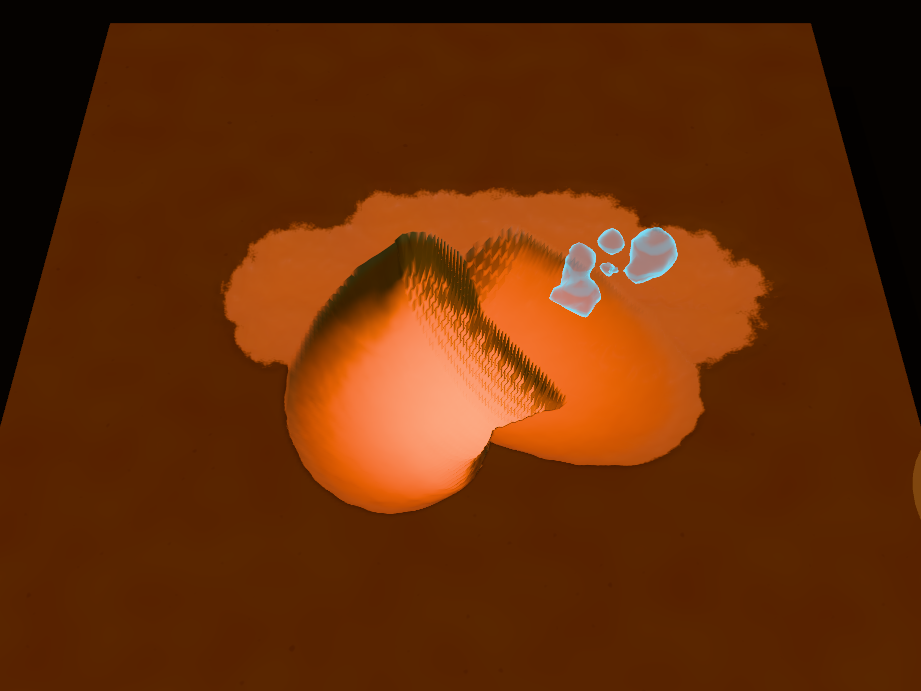
The diagram is a simplified explanation. The launchable slab is the actual experiment. The pumpkin’s separate lighting work also considers the point light and wall geometry; integrating a shallow surface study into that curved, carved shell is a further problem.
Choose the smallest useful model.
A heightfield is a good fit for shallow marks: it updates a small surface grid and preserves the accumulated cuts. It cannot describe an overhang or a scoop beneath intact skin, because a grid point stores only one height.
We also explored a three-dimensional distance field, which describes the solid throughout space and can retain an undercut. It costs more to store and rebuild. A pushed mesh was another experiment; its stretched faces and lost volume made it a poor substitute.
The heightfield answered the immediate tool question. The distance-field work remains useful for deeper removal and for the candle maker. Each model has a job; the flat slab does not establish that every curved-shell integration problem is solved.