Fitting movement to the body in front of us
Body plans, measured landmarks, skin-weight eligibility and controlled range sweeps for reconstructed character rigs.
Part 7 of 9From images to expressive 3D charactersSeries contents
- Building an expressive Giant Aperture mascot
- Turning reference pictures into a useful mesh
- Giving a mesh meaningful part labels
- Making painted eyes look and move like eyes
- Finding an ear and making it bend
- Turning a mouth line into an opening
- Fitting movement to the body in front of us
- Composing expressions and character behaviour
- Gaze, breathing and character behaviour
A surface label does not locate an interior joint
A skeleton that works on one character can put its joints outside another. The tempting shortcut is to scale an old answer to the new body. It fails when the head-to-body ratio, attachments or proportions change independently.
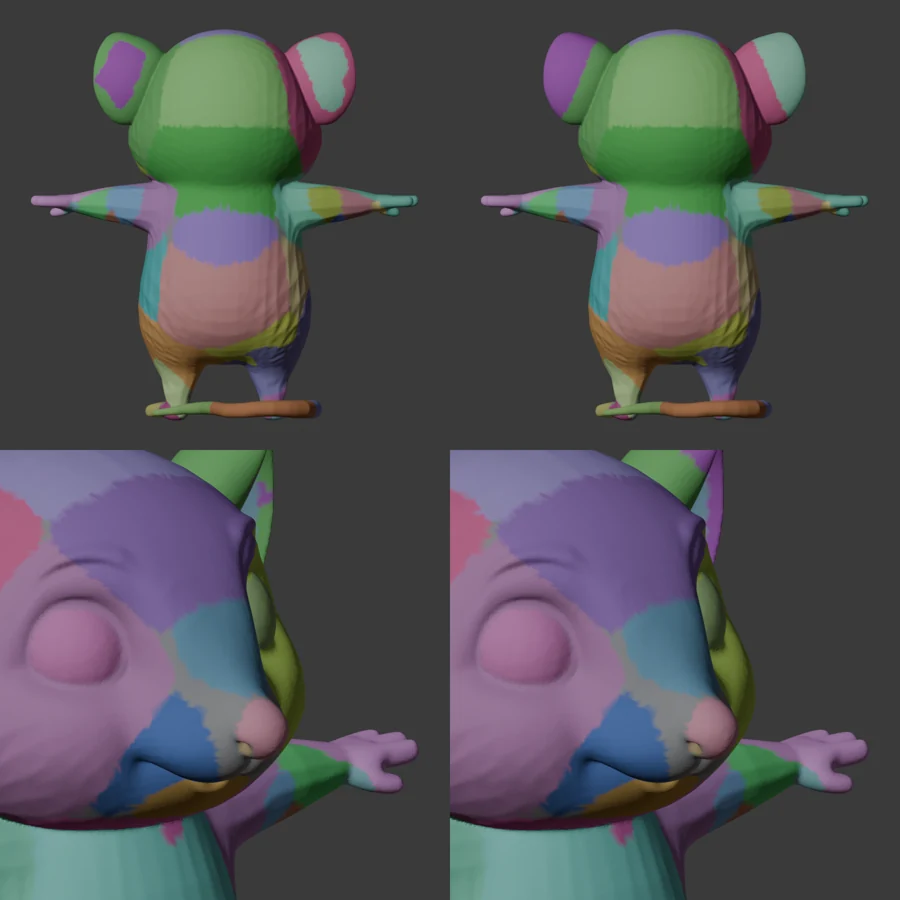
Declared body plans establish which structures the character has. Measurements then locate landmarks on the current geometry. A head label can constrain the search, but it cannot by itself tell us the centre of a shoulder joint inside the body.
Marker-guided fitting and skin binding are established rigging practice. Auto-Rig Pro, for example, distinguishes preset anatomy, reference-bone placement and binding. Our automation aims to recover useful fitting information from the labelled mesh, while retaining a small corrective handle when the surface cannot determine the intended joint.
Give each influence the skin it may move
A bone position and a skin-weight field solve different problems. The bone establishes a motion axis; weights decide which vertices follow it and how that influence blends into neighbouring motion.
Automatic binding is a starting point. Surface distance, semantic eligibility and local transition widths help stop an ear control from moving a cheek, or a jaw from dragging the back of the skull. The relevant scale is the feature’s own size and movement, rather than a constant proportional to whole-body height.
The flexible mechanism comes first: measure the attachment, derive the frame and express a falloff relative to that feature. A tuned constant is appropriate only when there is evidence for the specialization and its body limits are recorded.
Finding the working range is a stage
A rig that builds is not yet a rig that moves well. The range stage sweeps a requested movement from a small amplitude through a ladder of larger ones, measuring where deformation becomes unacceptable. The result belongs to this mesh and rig.
The small-motion control is essential. A discrete intersection test can report pairs even at a tiny rotation. Comparing each larger pose with that control helps separate a change caused by the motion from the detector’s existing baseline. An absolute count against zero can reject an otherwise useful movement for the wrong reason.
The stage measures directions, not only individual sliders. Axis sweeps establish basic ranges. Diagonal probes reveal interacting axes. Authored directions test a pose a person actually wants to use, including whether its full requested amplitude fits.
- Small-motion control
Establish the current body’s measurement baseline.
- Amplitude ladder
Increase one direction and record the differences.
- Combined directions
Probe interacting axes and authored poses.
- Saved limits
Tie the useful range to this mesh and rig.
A limit is evidence for a control
Measured ranges can inform a slider cap, an authored pose and the need for a corrective. They are more useful than a comment saying that a motion was once clean on a different character.
They are also incomplete descriptions. Several individually safe channels can fail in combination. A numeric measure can miss a loss of character, and a visually convincing front can hide a folded mouth interior. The stage needs both targeted measures and views that reveal the particular failure.
When a scoped measurement lacks anatomical fields, the report should say that it was skipped. Inventing a bounding-box substitute would make the output look more complete while changing the question being tested.
Automate the fitting, preserve the direction
A person should spend attention on silhouette, pose and what reads as appealing. Repeating landmark bookkeeping or painting around an avoidable eligibility leak consumes that attention without adding a creative decision.
The useful intervention is as small as possible: place an ambiguous attachment once, adjust a proportion or change the intended pose. The automation should carry that decision downstream and record enough evidence to repeat it. This is the goal of the fitting work, with body-specific limits made explicit rather than hidden behind a successful build.