Building an expressive Giant Aperture mascot
A procedural jelly giant, fourteen expression studies, and the controls that separate its face, gaze, squash and stretch.
Part 1 of 9From images to expressive 3D charactersSeries contents
- Building an expressive Giant Aperture mascot
- Turning reference pictures into a useful mesh
- Giving a mesh meaningful part labels
- Making painted eyes look and move like eyes
- Finding an ear and making it bend
- Turning a mouth line into an opening
- Fitting movement to the body in front of us
- Composing expressions and character behaviour
- Gaze, breathing and character behaviour
One character, several ways to feel
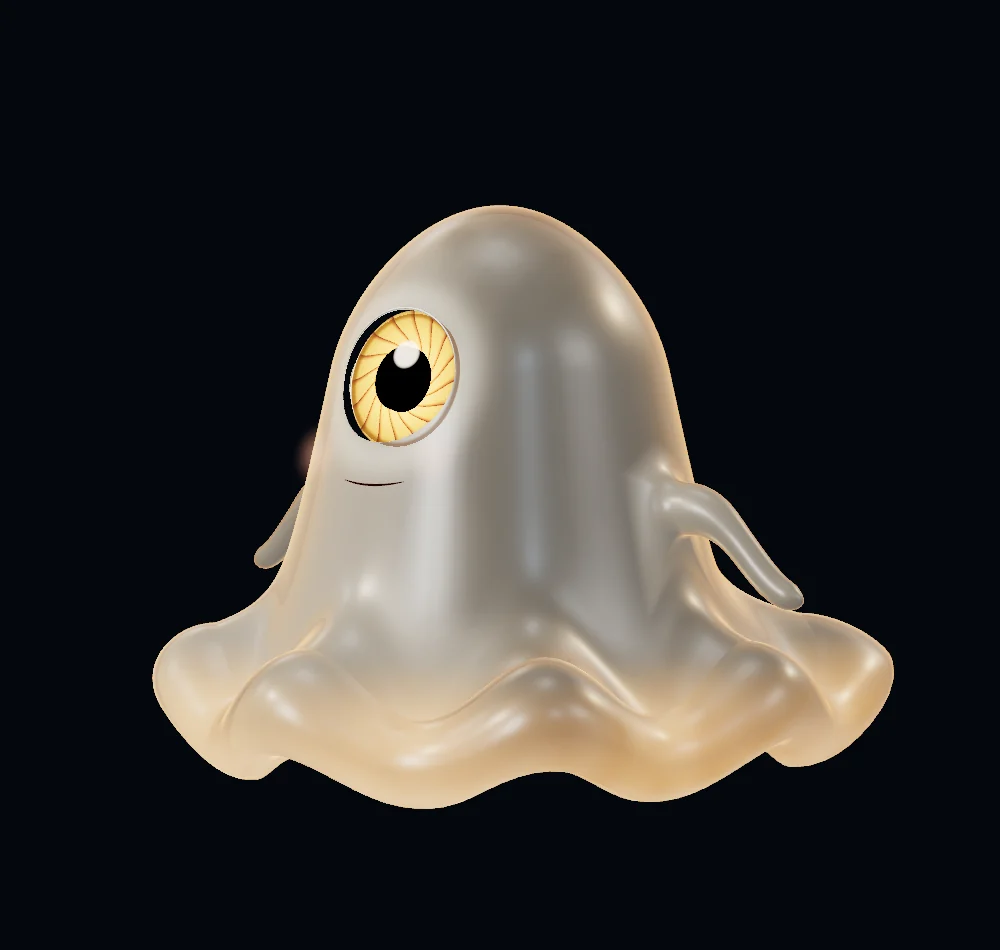
A single eye, a clear gel body and a ruffled skirt give the Giant Aperture mascot a simple silhouette. Making it expressive takes more than changing its smile. The eye needs to notice something, the body needs to respond, and the movement between those states needs to suit the feeling.
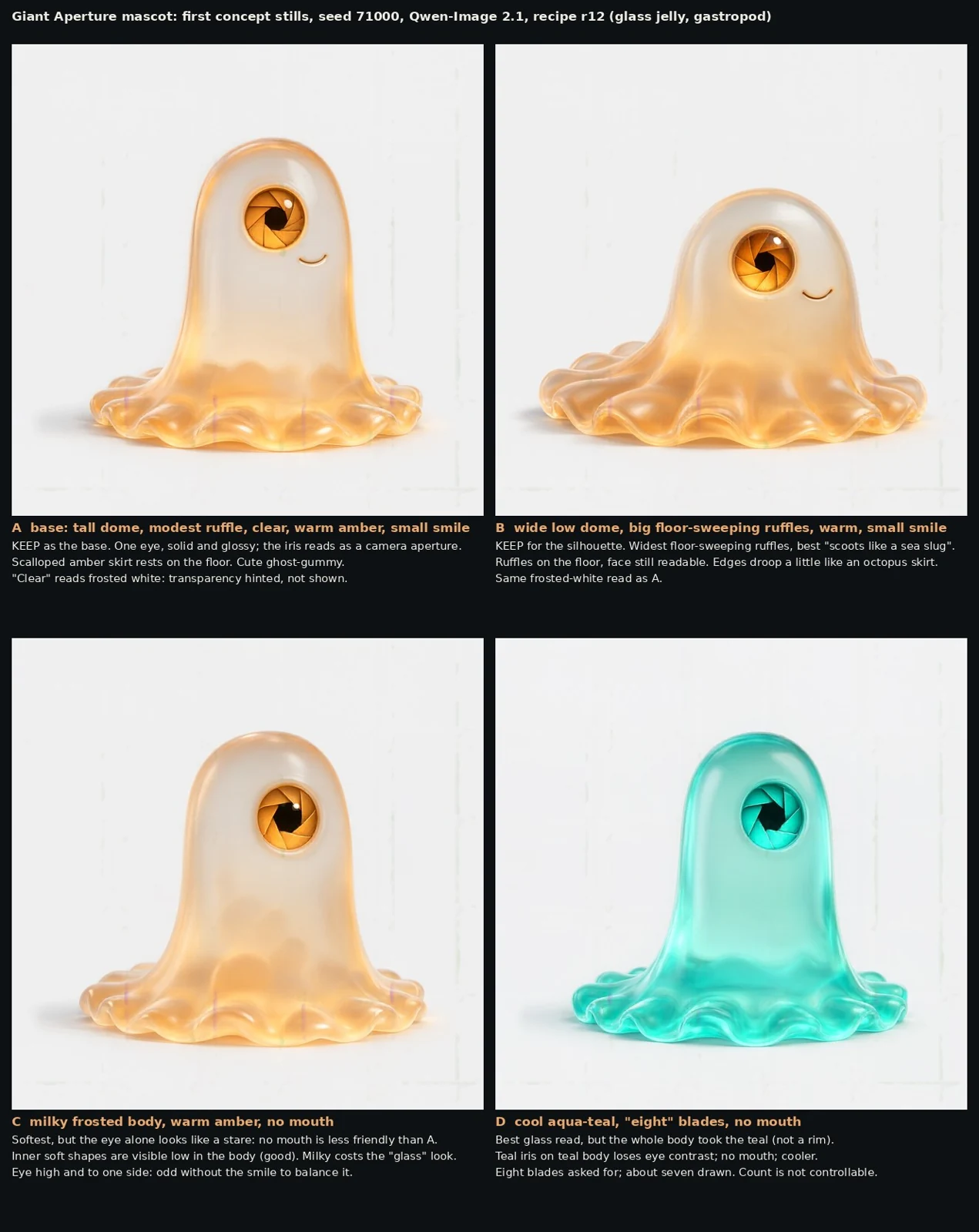
The first pictures explored a tall warm character, a low excited one, a frosted shy one and a cool teal one. We treated them as expressions of the same character. Height, skirt spread, clarity, colour and a smile became useful questions for the controls. The later work concentrated on the expressive jelly; an earlier attempt to make its silhouette read as the letter A was set aside.
That choice made a generated body useful. Instead of reconstructing four pictures as four separate objects, we could change one shape while keeping its eye, face and construction connected.
Generate the surface where it moves
The jelly is built in the browser from a shape description. A dome rises from a lobed skirt, with controls for the shoulder, lower width, rolled hem and eye placement. The generator already knows which vertices form its foot, rim, skirt, dome and eye socket.
Those construction zones give motion a place to act. A squash lowers the dome and spreads the skirt. A stretch lifts the body while the eye remains fitted to the changing surface. Local motion can then travel through the belly without passing through the face or pulling apart the hem.
This route suits a deliberately designed soft body. Reconstructed characters begin with triangles whose meaning must be recovered. They need labels and, where appropriate, skeletons and skin weights. The jelly uses its own surface controls and connects to the character stage through its own adapter.
Map a feeling to visible changes
The later atlas contains fourteen acting studies, from Calm and Curious to Surprised, Sleepy and Skeptical. Each combines body height with selected lid, gaze, brow and mouth targets. Small differences matter: Curious reaches up and looks around; Skeptical stays almost at rest while the half-lid, sideways gaze and uneven mouth carry the expression.
Surprised and Delighted both include upward movement, but they ask for different performances. Surprise enters quickly, widens the eye and forms a small round mouth. Delight briefly rebounds before settling into a lower smiling pose. The atlas records timing as well as targets.
These are editable acting proposals for this character. They do not assign a universal numerical meaning to an emotion. The companion expression article lets you inspect the actual authored values and the distinction between an atlas sequence and the live stage.
Keep the body recognizable as it stretches
Squash and stretch is established animation practice. An early jelly control compensated height with radius equal to the inverse square root of height. That is a useful starting relationship for a simple volume, but the dome, crown and skirt have their own rules. It does not guarantee constant volume for the completed mesh.
The later response uses a soft upper height limit and retains more shoulder width during a stretch. An upward reaction can then keep the broad, friendly body instead of becoming a thin tube. A separate, small belly deformation adds follow-through around the intended pose.
Animation Mentor’s account of squash and stretch emphasizes the visual judgment involved. Our contribution here is the dome-and-skirt parameterization, its silhouette limits and the separation of pose from local response. The person can adjust a contribution without rebuilding the character.
Let attention lead the body
Gaze has its own response: optical aim reacts first, eye placement follows, and the body turns more slowly. The character can notice a point before committing its whole shape to it. That sequence makes a simple pointer response feel more deliberate.
Expression transitions also preserve their current position and velocity when interrupted. Choosing a new feeling does not need to reset an unfinished movement. The face, body response and ambient life remain separate layers that need to be judged together.
The useful result is a controllable character study: choose an expression, adjust the part that matters, and keep the recognizable jelly underneath. The following chapters explore how to recover similarly meaningful controls from a character that begins as pictures.