Turning a mouth line into an opening
From an editable mouth line to local retopology, lips, an interior, jaw movement and protected lower-face deformation.
Part 6 of 9From images to expressive 3D charactersSeries contents
- Building an expressive Giant Aperture mascot
- Turning reference pictures into a useful mesh
- Giving a mesh meaningful part labels
- Making painted eyes look and move like eyes
- Finding an ear and making it bend
- Turning a mouth line into an opening
- Fitting movement to the body in front of us
- Composing expressions and character behaviour
- Gaze, breathing and character behaviour
Start with the line the person means
A painted smile is a line on a surface. An opening needs two lips, an interior and enough clearance to move. Giving the line those properties became a geometry pipeline of its own.
A saved mouth line on the current mesh takes priority. Otherwise the automatic stand-in uses part labels to locate the search and surface creases to propose a path. The implemented fallback can try side views or a painted line when front-view geometry does not provide enough evidence.
The candidate still has to pass anatomical checks: it must lie on the face and remain appropriately below the eye and nose evidence. If it cannot, the result records a refusal. The saved line is tied to the source mesh, so a decision on one surface is not silently replayed on another.
A smile can continue beyond the opening
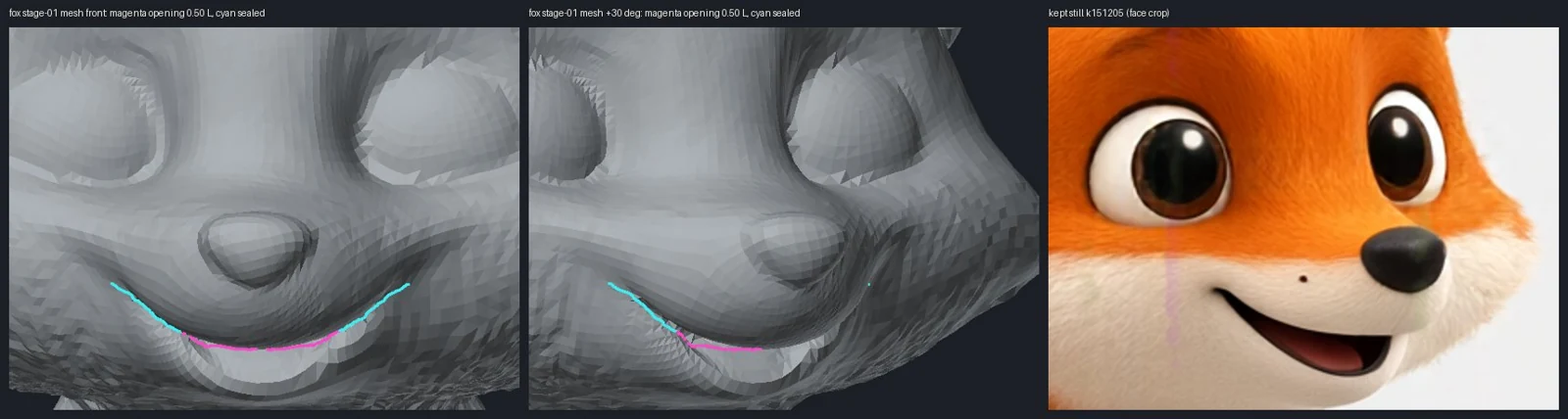
The full visible smile and the span that parts are different things. Cutting the entire painted curve can make the corners too wide or move them in the wrong way. Cutting too little without retaining the rest loses the original expression.
The line record therefore carries an opening span within the longer curve. The central part can become a seam with paired lip vertices, while the outer continuation stays sealed skin. The corner behavior must respect that difference; a sealed extension should not receive the same constraints as a cut endpoint.
This is a useful art-direction handle: one line places the smile, and a span selects how much opens. The following geometry derives from that choice. The person does not have to rebuild every surrounding loop to try a smaller mouth.
Change the local patch and preserve the rest
The retopology step grows a local surface patch around the line. It refines the patch, inserts the line and offset loops, and gives those boundaries to a quad mesher as constraints. The replacement is then welded back into the frozen surrounding mesh.
The goal is enough orderly structure for the lips to separate and deform, with explicit checks at the join. A successful remesh is not enough if it has folded a weld edge or changed distant vertices. The corners are especially demanding because several loops and the cut must meet in very little space.
Opening the seam creates lips and a mouth bag. Tongue and teeth are separate interior pieces with their own placement and parenting. They need clearance inside the measured cavity; an attractive tongue in a target picture does not prove the reconstructed head has room for it.
Make the jaw move the intended skin
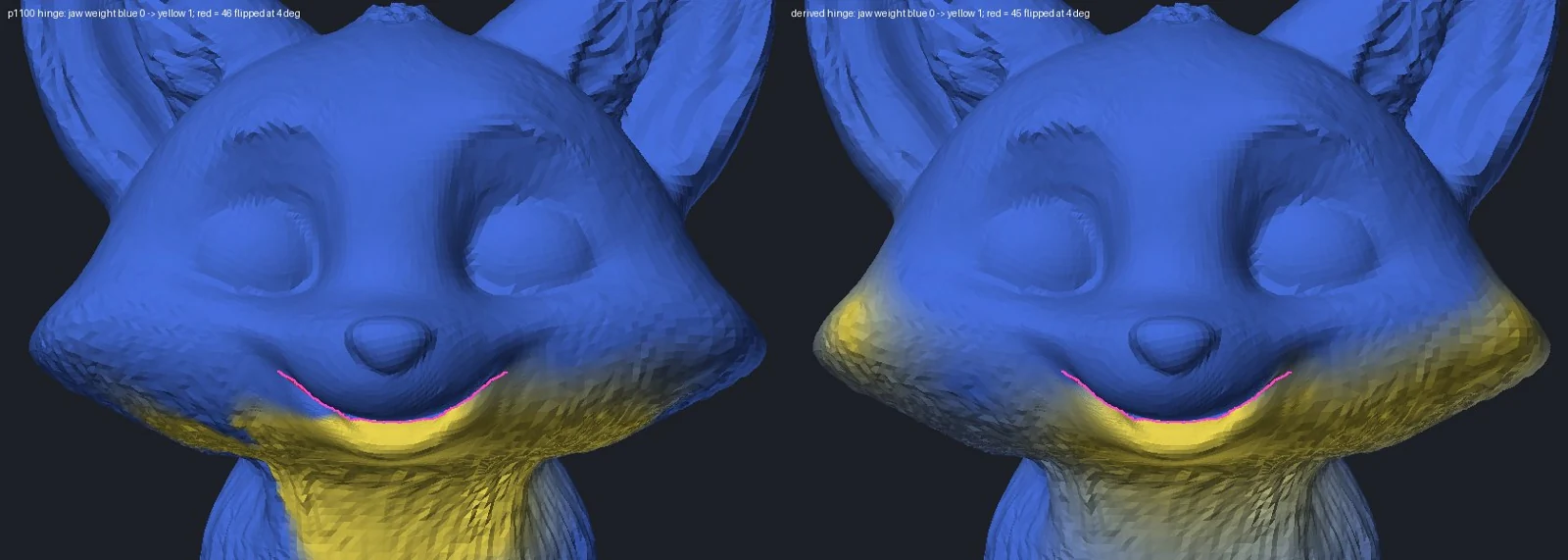
The jaw hinge and mouth fields are fitted on the mesh in hand. Smooth harmonic weight fields distribute motion around the lips and corners. The usable opening is measured rather than borrowed from another head.
The historical hinge comparison below shows why that measurement matters. Similar colours at the front concealed triangles that flipped inside the mouth at a small angle. Changing the hinge alone did not solve that build. Looking only at the flattering front would have missed the failure.
Later lower-face work confines talking squash to lips and cheeks while protecting the eye and brow. A mouth control that moves the entire face may appear expressive in isolation while damaging every combination with gaze or blinking.
An opening is a chain of dependent choices
A readable mouth depends on the line, the opening span, local topology, corner treatment, interior and measured deformation working together. Passing an individual stage does not establish a complete expressive face.
The method is built around supported soft-lip surfaces with a resolved line and enough anatomical evidence. A beak, a purely graphic mouth and a mechanical opening need their own construction. Keeping those limits explicit lets the automatic work carry a person from one useful line to editable movement without claiming to solve every kind of face.