Finding an ear and making it bend
Recover an ear’s attachment, path and movement from the current mesh, including upright and hanging shapes.
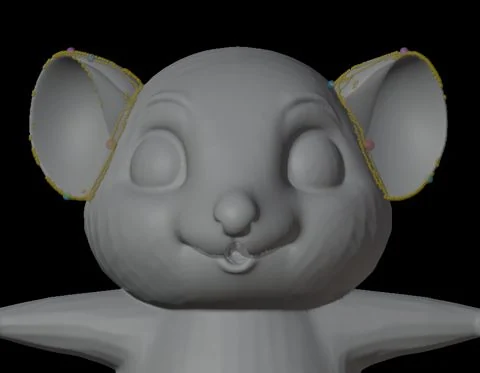
Part 5 of 9From images to expressive 3D charactersSeries contents
- Building an expressive Giant Aperture mascot
- Turning reference pictures into a useful mesh
- Giving a mesh meaningful part labels
- Making painted eyes look and move like eyes
- Finding an ear and making it bend
- Turning a mouth line into an opening
- Fitting movement to the body in front of us
- Composing expressions and character behaviour
- Gaze, breathing and character behaviour
A reusable method cannot keep the old ear’s coordinates
An ear is easy to recognize in a picture. Its attachment and bend are harder to recover from a reconstructed mesh, especially when its back joins the head or its tip hangs below the root.
An early configuration stored hand-measured base and tip coordinates from one sculpt. When a later body changed proportions, those answers no longer belonged to its surface. The documented failure put old tips outside the skin while downstream checks still used the old frame.
The replacement derives a frame from the current region data and measured landmarks. The important reuse is the method—find the attachment, establish a direction, apply a local falloff—rather than preserving a coordinate that happened to work once.
Follow the ear instead of sorting it by height
The search begins with the connected ear region and its attachment to the head. Local thickness and a path through the blade help establish the centreline. Cross-sections along that path provide more useful structure than a single bounding box.
For an upright ear, the tip may be near the highest part of the region. For a hanging ear, that shortcut can select the root instead. Following the path through the ear allows a distant, low tip to remain the tip.
The two sides are measured separately. A sculpt can be asymmetric, and forcing a mirrored frame can hide a one-sided fitting error. Saved frames also need to identify the surface they came from; a matching filename is not evidence that an attachment was measured on the mesh being deformed.
- Connected region
Find the ear belonging to this labelled surface.
- Attachment
Measure the root where it joins the head.
- Path and sections
Follow the blade through its thickness.
- Chain and weights
Fit movement using this ear’s frame and stiffness.
The blade and its attachment have different jobs
An ear blade can be expected to stay comparatively rigid while its attachment blends into the head. Measuring both populations as one object confuses that expected blend with a deformation defect.
The ear-shape checks therefore distinguish the blade from the attachment band. Soft and rigid ear types also have different expectations. The question is whether the intended ear moved cleanly, not whether every vertex maintained the same distance from every other vertex.
Skin eligibility matters at the base. A local ear influence should not leak across the head or take an unrelated cheek with it. Equally, pinning the entire attachment can create a hard crease. The band is the transition that lets the measured ear move while the head remains coherent.
Measure the bend on the fitted body
Placing a chain is only a construction result. A movement sweep is needed to find the range in which that chain, the weights and the surface agree. An upright roll, a hanging-ear fold and a stiff mechanical flap are different requests.
Combined motion needs attention too. A roll and a yaw that each work alone can fail when used together. The shared range work includes diagonal and authored motion directions so the controls can expose that interaction.
The reusable handles are the declared ear type and its stiffness, followed by movement within the fitted range. They communicate intent with a small number of choices. The geometry work should derive the location and scale rather than ask a person to replace dozens of coordinates.
Say when the method does not apply
This stage is for declared ears with enough connected surface and useful attachment evidence. An earless body is a legitimate case that skips it. A badly fused or mislabeled ear is an unresolved input, not permission to reuse another character’s frame.
The broader lesson appears throughout the series: store parameters for finding a feature and the measured result for this build. Keep them distinct. That is what makes a correction survive the next character rather than becoming another carefully tuned exception.