Compare the job, then the model
We wanted characters we could turn around, paint and eventually move. A good front view was only the beginning. The questions were whether the reconstruction kept the character’s shape, what it invented behind that view, and how much work remained before we had a useful asset.
We compared TRELLIS.2, Hunyuan3D 2.0 and 2.1, and Pixal3D’s single-image and multiview checkpoints. Those names need their version and task attached. Hunyuan3D-2mv is a multiview shape model; Hunyuan3D-Paint 2.1 paints an existing surface. Using one does not require using the other.
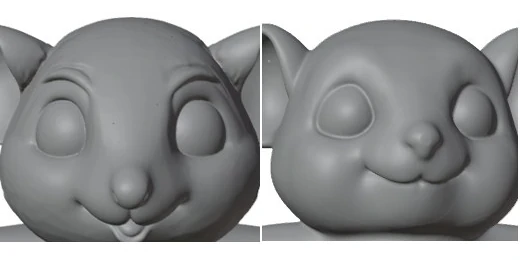
The mouse examples below come from a September 2026 study that also included a fox, dragon and gecko. Hunyuan 2.1 gave us smoother surfaces; TRELLIS and single-image Pixal retained stronger carved detail. Some of that detail was useful facial structure, and some was fur-like relief or surface noise. We had to inspect what the extra geometry was actually doing.
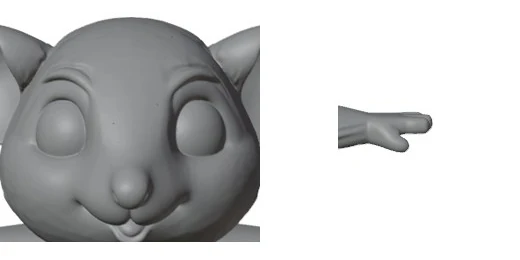
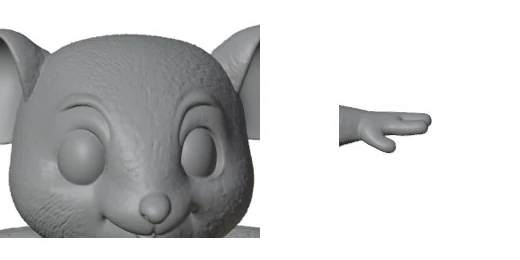
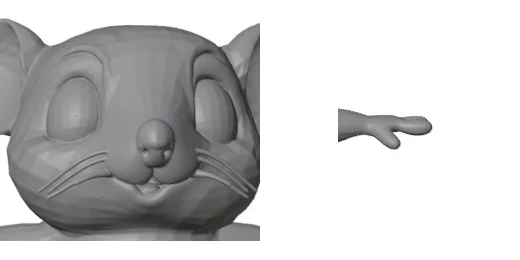
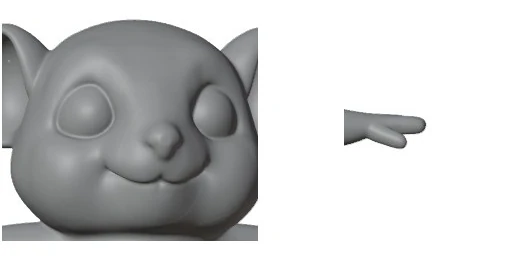
Retained 29 September study, before shared cleanup. Each backend has its own conditioning and native export processing; these are not four equally processed decoder meshes. Original runtime manifests are missing for several arms, so this is a visual comparison rather than a controlled speed or accuracy ranking.
Name the surface we are judging
Our earlier Ripley comparison exposed an easy mistake: calling every export “the TRELLIS mesh”. The decoder produced about 6.08 million triangles. Remeshing, smoothing and simplification produced a 699,511-triangle surface. Painting used another derivative with 99,998 triangles. Each was useful for a different question.
Extraction mattered too. Hunyuan 2.0’s original voxel-face extraction left terraced bands. Extracting a new surface from the saved intermediate model state with marching cubes removed much of the banding, while the face remained soft. Increasing extraction resolution added triangles and time without clearly recovering new eye, nose or mouth structure. A denser mesh did not settle the detail problem.
Three surfaces from one reconstruction
The historical Ripley comparison kept the decoder output, a processed mesh and a smaller paint input. The word “mesh” alone did not say which one we were judging.
Ripley · triangle counts
The processing changes both geometry and cost. Judge the silhouette and attachments again after simplification.
Generate a missing view, then question it
One image leaves the back, underside and hidden attachments open to interpretation. We used Qwen-generated turnarounds to propose those views, keeping the selected character picture as identity and checking pose, proportions and camera. The new view gives us something concrete to inspect and steer.
That only helps reconstruction when the views agree. In the four-body study, Pixal’s generated-view packs matched their own views better, yet the fox and dragon moved further from the original three-quarter drawing. The sheet had redrawn the character. Agreement with newly generated pictures was answering a different question from preserving our starting design.
Camera handling could also overwhelm the apparent model difference. A separate three-mesh test found that shared framing and the correct field of view materially changed Pixal3D’s multiview result. Cropping every view independently broke the relationship the checkpoint expected. We now treat the view layout and camera contract as part of the input.
The reference article works through a real dog pack and a fox sheet that changed the pose. Extra images become useful when their camera and design assumptions are inspectable.
Count the work after the model returns
On that September 22 test, warm Hunyuan 2.1 shape generation took 49.4 seconds from prepared image to raw mesh and retained latent. TRELLIS took 31.7 seconds to produce both raw and processed exports. These RTX 5090 observations have different endpoints and processing settings. Model loading, UV preparation—laying the surface out in a flat texture image—and inspection were additional costs.
The downstream cost could dominate. Hunyuan Paint stalled in UV preparation on a 7.1-million-triangle input, before it reached diffusion. A later 100k-triangle derivative recorded about 54.7 seconds of warm painting and export once its UVs were prepared, but retained small coverage defects. Producing a textured file was a useful result; it did not complete delivery review.
This changed what we timed. Shape generation ends at a surface; a useful paint input also needs an affordable triangle count and usable UVs. Delivery adds inspection of attachment, colour coverage and deformation. Comparing a raw export from one backend with a cleaned and painted result from another hides where the work went.
Hand a known surface to the next stage
A reconstruction should leave a clear handoff: which selected picture it followed, how the surface was extracted and processed, and what derivative goes to painting. We can keep a TRELLIS shape while testing another painter. That is useful only when the derivatives stay identifiable.
A plausible front also needs inspection from the side and behind. A sculpted smile, fused fingers or a tail entering the trunk can survive a good-looking render. More texture detail cannot fix that geometry.
Painting then introduces different failure modes: a surface can have no accepted colour source, or its UV island can have too little room for the detail. Those deserve their own explanation rather than another model ranking.
Painting a character follows the six guided views, view ownership, surface-neighbour filling and UV allocation. Its final section separates the historical extra-camera labelling work from the current painter.
Keep enough information to change the model
The comparison left us with a more useful habit than a permanent winner. Keep the selected source and its role, the actual checkpoint, camera and crop settings, the exported surface’s processing, and the endpoint of every timing. Then inspect form, paint, UV allocation and part coverage separately.
A model swap should replace a declared stage without silently replacing the character or erasing the checks around it. The tools can expose the gap and carry a decision forward. Choosing the shape we like, or deciding what an unseen marking should be, stays an art-direction choice.